
San Saba Unit Release Paths
San Saba Unit, also called N2, is a state prison. A person leaving it may transfer to another TDCJ unit and remain incarcerated. The person may be released on parole or mandatory supervision while still under legal supervision. A flat discharge means the sentence has expired without remaining parole supervision. These outcomes should not be grouped under the loose phrase “released from the unit.”
TDCJ Review and Release Processing checks a proposed residence, county-of-residence rules, discipline, program issues, mandatory conditions, and other criteria before issuing a release certificate. A scheduled location may appear after processing reaches that point. It can still change. The official record, not a planned pickup, determines what occurred.
Search San Saba Unit Custody
Start at the TDCJ inmate-information hub and follow the Online Inmate Search. A TDCJ number or state identification number gives the strongest search. If neither is known, search by name and available demographic filters, then compare age, conviction county, and offense before relying on a result.
- Enter the TDCJ number or SID when available.
- Otherwise search by name and narrow with supported details.
- Open the matching record and verify the assigned unit.
- Read projected, parole-eligibility, maximum-sentence, and scheduled fields separately.
- For a former inmate, request incarceration history and actual release data from TDCJ.
The statewide locator is for people currently incarcerated in TDCJ. It is updated on working days, and TDCJ says displayed information is at least 24 hours old. Once a person is released or discharged, the current-inmate portal should not be expected to serve as a historic released-person index. The countywide San Saba release guide explains why county-jail records use a different route.
San Saba Unit Date Fields
TDCJ date labels are not interchangeable. A projected release date is a calculation by Classification and Records based on the offense and offense date. It is the date the person is projected to leave incarceration if not paroled sooner. It is not proof that release happened.
| TDCJ field | What it means |
|---|---|
| Projected Release Date | Calculated possible exit if parole does not occur sooner |
| Parole Eligibility Date | When the person may become eligible for parole review |
| Maximum Sentence Date | The sentence's outer date as shown by TDCJ |
| Scheduled Release Date | A planned date after release processing advances |
| Scheduled Release Location | The planned processing location, subject to change |
TDCJ's ombudsman warns that a scheduled date can change even on that day. Holds, release-plan review, discipline, court action, or other processing can affect timing. Confirm an actual release after the event rather than treating a projected field as final.
San Saba Unit Records Contact
The official unit directory lists San Saba Unit at 206 South Wallace Creek Road, San Saba, Texas 76877, with telephone (325) 372-4255. The unit can address facility-specific questions, but archival incarceration and release data belong with TDCJ's records channels. The research does not identify public release hours or a general family waiting schedule, so confirm case-specific logistics directly.
TDCJ San Saba Unit (N2)
206 South Wallace Creek Road
San Saba, TX 76877
(325) 372-4255
TDCJ Correctional Institutions Division
For an information inquiry, email pia@tdcj.texas.gov with the full name and seven-digit TDCJ number. If the number is unknown, TDCJ asks for exact birth date or approximate age and conviction county. The email service can provide incarceration history, offenses, conviction county and court, current incarceration, and projected release date at no charge. Telephone and a Texas Public Information Act request provide further channels.
Inside San Saba Unit
The official TDCJ San Saba Unit page lists male G1 and G2 custody and a capacity of 606. The page captured in the project image shows the official unit details used to distinguish this prison from the former county lockup.
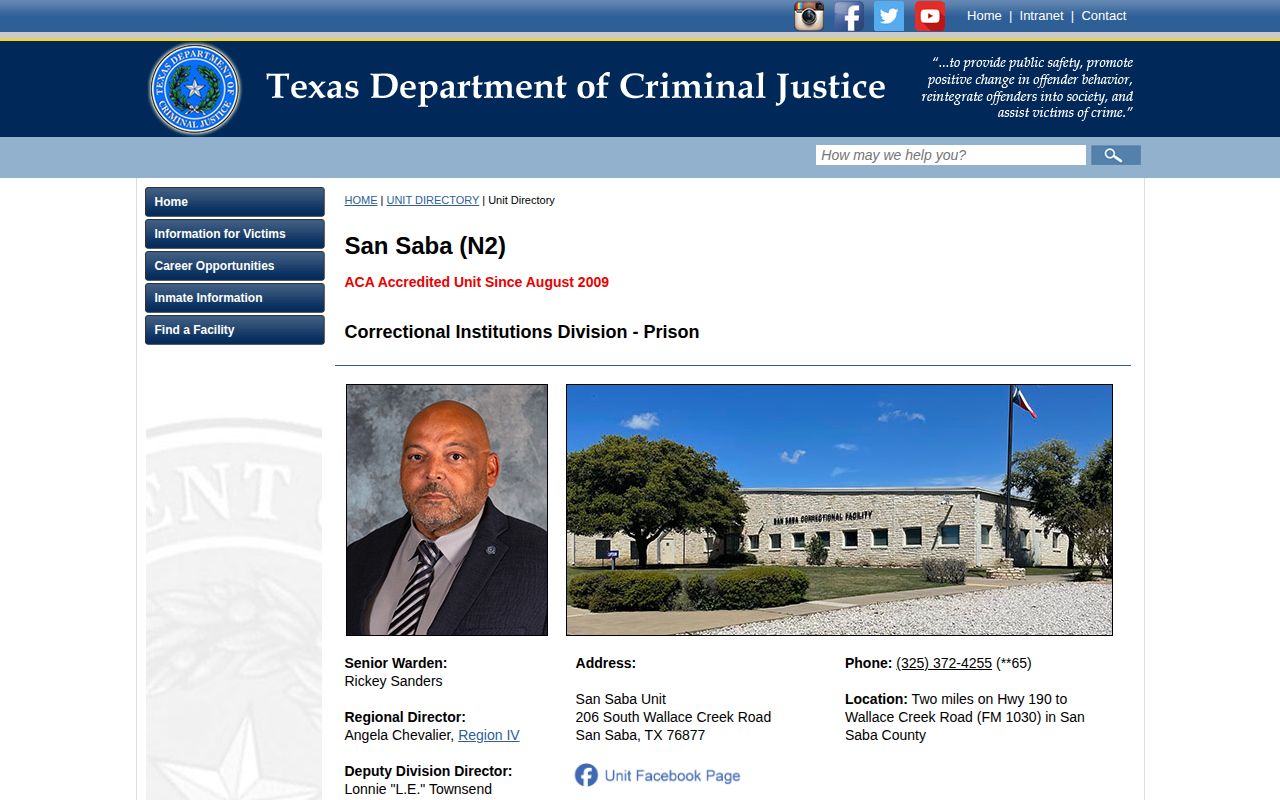
The unit began in June 1992. It transferred to the Texas Youth Commission in February 1996 and then to TDCJ in September 2007. Its address inside San Saba County does not place its inmates in county custody. A San Saba Unit assignment reflects TDCJ's prison system, while a “San Saba County inmate” may refer to a local case housed in Bell County or another receiving jail.
Confirm San Saba Unit Release
For a completed movement, ask TDCJ for actual release or discharge date and type, release certificate information, and incarceration history. If parole or mandatory supervision applies, confirm supervision through TDCJ parole channels. If the result was transfer, use the new TDCJ unit assignment and do not describe it as release to the community.
A blank or missing current location is not enough. It may result from data timing, transfer, or the locator's current-inmate scope. Email, telephone, and a formal records request are the archival fallback. State the exact question: whether the person was discharged, released to parole or mandatory supervision, or transferred on the relevant date.
TDCJ says photographs and Social Security numbers are not supplied through its email information service. Request only the fields needed to establish custody history and release. A focused inquiry with the correct TDCJ identifier reduces name confusion.
Parole and Mandatory Supervision
Parole is conditional release approved through the Texas parole process before the full sentence expires. Mandatory supervision is a statutory form of supervised release that may apply when eligibility and time calculations are met. Both allow physical release from prison while legal supervision continues. They are not the same as flat discharge.
Release processing reviews the residence plan and required conditions before a certificate is issued. The planned county of residence can matter, and the release site need not be the prison gate a family expects. Scheduled details may change. Confirm them through TDCJ rather than relying on an old search result or informal message.
When supervision begins, the parole record becomes part of verification. Ask for the release type, effective date, and supervising channel. If the sentence instead expires, request the discharge date. That distinction explains whether TDCJ retains supervisory authority after the person leaves incarceration.
Transfers Are Not San Saba Releases
A transfer from N2 to another TDCJ unit changes location but not state custody. The statewide search may update after the move, subject to its working-day schedule and data lag. A person can leave San Saba Unit without being released from TDCJ.
This point is especially important because the county has three very different custody paths. The former local lockup no longer houses inmates. Bell County can hold some San Saba County detainees under contract. San Saba Unit houses state prisoners assigned by TDCJ. A name connected to “San Saba” does not identify which system controls the record.
Use the booking agency for a local arrest, Bell County for physical custody there, and TDCJ for an N2 prisoner. Following the correct custodian prevents a county clerk or Sheriff from being asked to verify a state-prison movement outside that office's records.
San Saba Discharge Evidence
The strongest proof of a past San Saba Unit release comes from TDCJ incarceration history and the actual release or discharge record. A court judgment explains the sentence, but it may not reflect every later prison calculation or release-processing change. A projected date forecasts an event. It does not document completion.
Keep the offender identifier, date searched, and field labels in a small verification log. When requesting records, include known name variants and conviction county. Ask TDCJ to distinguish parole, mandatory supervision, flat discharge, and transfer in its response.
For a current inmate, the locator provides the first check. For a former inmate, use TDCJ's email, telephone, parole status, or Public Information Act route. That division between current search and historical record is the clearest way to verify someone who once left San Saba Unit.