
San Saba Projected vs Actual Release
TDCJ defines a projected release date as the date Classification and Records calculates for an inmate to leave incarceration if parole does not occur first. It is a forecast based on the sentence, offense, offense date, credit, good time, and statutory rules. The parole eligibility date only marks when consideration may begin. The maximum sentence date is the sentence-expiration endpoint under the applicable calculation.
A scheduled release date and scheduled location can appear later, after processing has advanced. TDCJ warns that even a scheduled date may change on the date itself. Actual release is proved by the completed custody transaction or discharge record, not a forecast copied earlier.
A pretrial San Saba detainee has no sentence-based projected date. Bond, dismissal, a plea, a court order, transfer, or a detainer may drive the next move. The court record explains legal authority; the custodian records the time and destination.
Find a San Saba Projected Release
First determine who holds the person. San Saba County's old lockup is no longer an ordinary detention site, and local detainees may be held by Bell County or another contractor. San Saba Unit is a state prison and uses the TDCJ route. These paths cannot be swapped.
- Use the booking and cause numbers to identify the originating case and physical custodian.
- For a current TDCJ inmate, open the TDCJ Online Inmate Search and match identifiers, offense, age, and conviction county.
- Read projected release, parole eligibility, maximum sentence, current facility, and any scheduled fields separately.
- For a county sentence, obtain the judgment, jail-credit finding, and custodian's time-calculation or release transaction.
- For a pretrial case, follow the bond and court orders rather than calculating a date.
- Confirm close to release because holds, transfers, decisions, and record timing can change the result.
The San Saba County released-inmate lookup provides the wider verification path when the person has already left the live roster.
Texas Good Time for San Saba
Texas Government Code Chapter 498 governs good-conduct time. Section 498.003 says good time applies to eligibility for parole or mandatory supervision and does not otherwise shorten the court's sentence. Credit can be forfeited and may be restored under law and TDCJ rules.
For an eligible offense committed before September 1996, TDCJ calculates projected release when calendar time plus good time equals the sentence. For an eligible offense on or after that point, discretionary mandatory supervision also requires BPP approval. A denial can move the projected date to maximum expiration unless a later approval changes it. Section 508.149 lists exclusions, while Sections 508.147 through 508.149 govern the related review and release framework.
Offense date matters. So do the conviction, deadly-weapon finding, consecutive sentences, credits, discipline, parole vote, and mandatory-supervision eligibility. A simple percentage cannot account for this mix.
Why San Saba Release Dates Change
A date can change because the inputs or legal posture change. TDCJ data is updated on working days and displayed information is at least a day old, which adds another reason to treat a portal value as a snapshot.
| Factor | Possible effect | Best confirmation |
|---|---|---|
| Good-time loss or restoration | Revises the TDCJ calculation | Classification and Records |
| Parole vote | May authorize an earlier release or defer it | BPP status and release processing |
| Mandatory-supervision review | Approval or denial can move the projected date | BPP and TDCJ record |
| Detainer or hold | Changes destination and may prevent community release | Custodian and holding agency |
| Court order or sentence correction | Changes the legal basis or credit | Signed judgment and docket |
| Program or release-plan issue | Can delay scheduled processing | Review and Release Processing |
Note: A transfer changes location but does not by itself end county, state, federal, or immigration custody.
Confirm San Saba Actual Release
For TDCJ, Classification and Records audits the release certificate and calculates the date. Agency guidance says that audit commonly takes about 14 to 21 business days. When release depends on a required program and an approved residence, processing may take roughly four to six weeks after program completion. These are estimates, not promises.
Review and Release Processing checks the plan, residence rules, discipline, programs, and special conditions. Its contact is 8610 Shoal Creek Boulevard, Austin, TX 78757, (512) 406-5449. TDCJ email information can provide incarceration history and projected-release details at no charge, while a formal public-information request is the fallback for archival release or discharge records.
Texas IVSS-Counties may provide county status alerts, but San Saba participation was not confirmed. TDCJ has a separate state notification service. In either system, an alert is a lead. The completed agency record is the proof.
No Universal Texas 85 Percent Rule
Texas does not require every inmate to serve about 85 percent of a sentence. For ordinary eligible cases under Government Code Section 508.145, calendar time plus good conduct time can reach parole eligibility at one-fourth of the sentence or 15 years, whichever is less. Covered aggravated, deadly-weapon, and other listed cases generally require actual calendar time equal to one-half of the sentence or 30 years, whichever is less, subject to statutory minimums. Some categories have distinct rules.
This is why an online calculator that applies one rate is unreliable. The official record must be read with the offense and offense date. A projected release date is not the same as parole eligibility, and eligibility does not guarantee a favorable vote.
The TDCJ definitions page illustrates the official terms used in the date record:
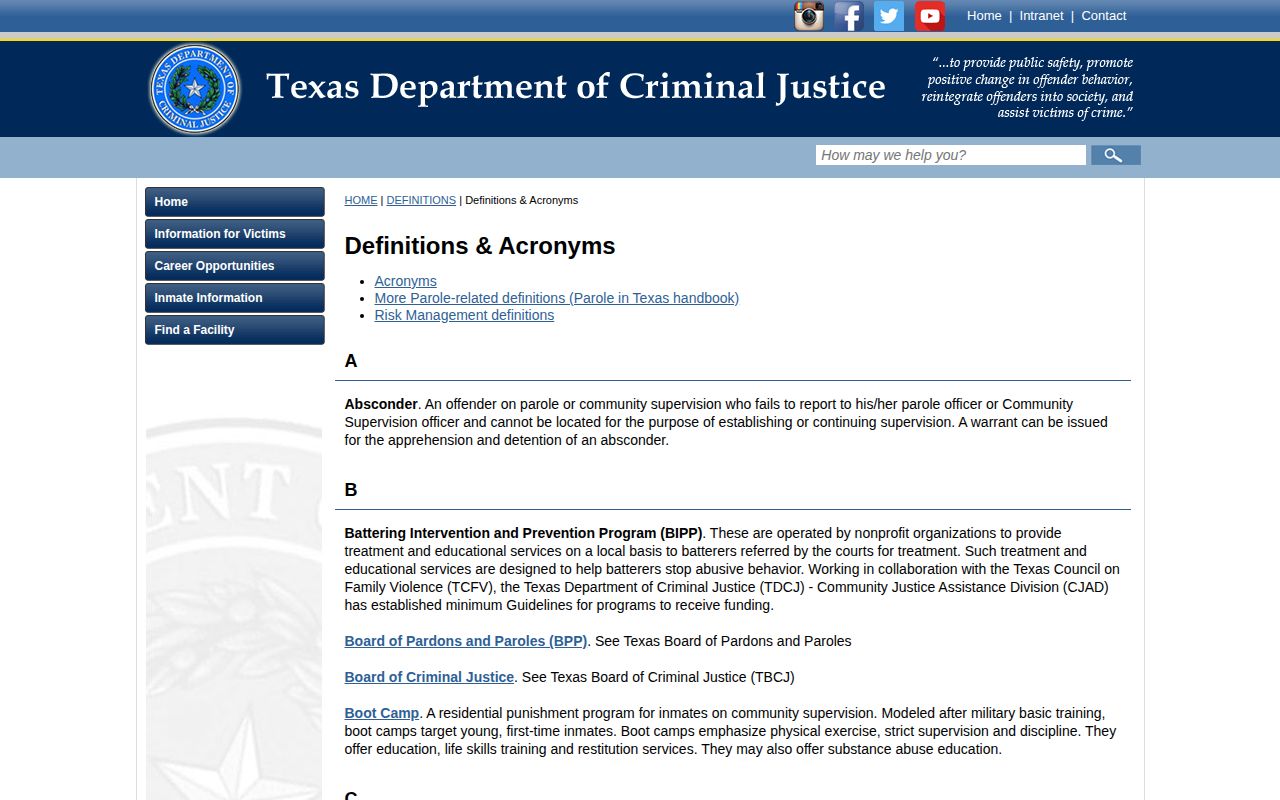
The captured official page helps separate date labels before any conclusion is drawn.
San Saba County Sentence Calculations
Do not apply TDCJ projected-release fields to a county jail sentence. The county sentence must follow the judgment, jail credit, applicable law, and authorized time accounting. San Saba publishes no local good-time formula, weekend-release practice, or online projected-date tool.
Because local detainees are housed outside the former lockup, ask which agency performed the calculation and which agency will process release. Request that custodian's calculation or release transaction and compare it with the signed judgment. San Saba remains the originating case authority, but Bell County or another jail may hold the physical timestamp and destination.
Note: A blank TDCJ result does not prove release because the public web locator is limited to current incarceration.
San Saba TDCJ Date Fields
The statewide search accepts a TDCJ number, SID number, last name with first-name information, gender, and race. A number is stronger than a name because it reduces collisions. When no number is known, an email request may add exact birth date or approximate age and conviction county.
A detail record can provide identifiers, age, current facility, offense, conviction county, case data, maximum sentence date, projected release date, and parole eligibility date. Scheduled fields appear only when processing reaches that stage. Each field answers one narrow question. None is a historical county release sheet.
The public locator expressly covers current TDCJ incarceration and is updated on working days. Displayed data is at least 24 hours old. A discharged person or historical incarceration may require email, telephone, or a Public Information Act request. Ask for incarceration history and actual release or discharge date and type. A missing current location does not prove freedom from all custody.
San Saba Release Location Changes
A date without a destination can mislead. A person may leave Bell County for the community, return to San Saba authority, enter TDCJ, or move on a state, federal, or immigration hold. The local transaction should identify release type and destination when those fields exist.
For San Saba Unit, a move to another prison remains TDCJ custody. Parole and mandatory supervision mean physical release under continued legal custody. Flat discharge means the sentence ended without a remaining parole obligation. Those outcomes can share a departure date but have different legal effects.
When another agency takes custody, request the transfer date and receiver from the sending custodian, then confirm intake with the receiving agency. The judgment proves legal outcome; the custody transaction proves physical movement.
San Saba Historical Release Dates
The online TDCJ search is not a complete archive of people who have left state custody. When the person no longer appears, email TDCJ with the full name and seven-digit TDCJ number. If that number is unknown, provide an exact birth date or approximate age and the county of conviction. Ask for incarceration history, offense and court information, and the actual release or discharge date and type.
Telephone service is another official channel, and a focused Public Information Act request is the archival fallback. For a county sentence, direct the request to San Saba and the identified physical custodian. Ask for the judgment calculation, release transaction, timestamp, coded disposition, and destination. If an agency supplies a code without a legend, request its existing definition instead of guessing.
Historical proof should preserve source roles. The court supplies the legal order. The jail or prison supplies physical movement. Parole records show continuing supervision. Comparing those records is more reliable than treating one absent search result as a completed discharge.