
San Saba Probation vs Parole
San Saba County probation begins with a court order. Texas law often calls it community supervision. It may follow a conviction or a deferred-adjudication order and can be used instead of a prison term. Local supervision is administered through a Community Supervision and Corrections Department. The court docket and signed order are therefore the best starting points.
Parole follows incarceration in TDCJ. Mandatory supervision is another form of release from state prison, but it follows a distinct statutory process. TDCJ defines a releasee as a convicted person serving part of a sentence in the community while reporting to a parole officer and following imposed conditions. Not every person released from the San Saba County system is a parolee.
| Point | Probation | Parole or mandatory supervision |
|---|---|---|
| Who orders it | The criminal court | Texas release law and BPP/TDCJ process |
| Custody path | May be imposed instead of prison | Follows TDCJ incarceration |
| Local verifier | Court clerk and San Saba adult probation | TDCJ, BPP and Brownwood District Parole Office |
| Ending record | Court discharge or case order | Sentence completion or formal discharge |
- Parole
- Conditional community release before the maximum sentence date.
- Probation
- Court-ordered community supervision that may replace confinement.
- Mandatory supervision
- A statutory form of TDCJ release subject to eligibility and review rules.
- Discharge
- The formal end of the sentence or supervision obligation.
Check San Saba Post-Release Supervision
Start with the underlying custody path, not a guess based on where the arrest happened. A San Saba County case may lead to local probation, while a person released from San Saba Unit or another state prison may be on parole or mandatory supervision. The live TDCJ inmate search chiefly covers people still incarcerated, so a past release can require direct TDCJ information or a public-record request.
- Identify the court, cause number, and conviction county from known records.
- Read the judgment and later orders for community supervision, revocation, extension, or discharge.
- For a state-prison path, check TDCJ and BPP status information using a TDCJ or SID number when available.
- Match a local probation order to the San Saba CSCD; match parole or mandatory supervision to the Brownwood office.
- Ask only for information the office may lawfully confirm and obtain public orders from the clerk.
- Record the source and date, then verify any claimed change with the issuing agency.
The San Saba County released-inmate search explains how the court, physical custodian, and state record fit together when the custody path itself remains unclear.
San Saba Probation Office
Local adult probation is based in the San Saba courthouse. No public online supervisee roster, absconder list, published office hours, or general check-in instructions were found in the official-channel review. That makes the court order and direct office routing important. Operational case notes may remain restricted even when the judgment is public.
Adult Probation / CSCD
500 E. Wallace, Suite 111
San Saba, TX 76877
(325) 372-3285
Fax: (325) 372-6445
The official San Saba probation page identifies the local office. A requester should bring the cause number and use the clerk for public court orders rather than asking staff to disclose confidential supervision material.
San Saba Supervision Violations
Conditions vary by order and case. They can require reporting, lawful conduct, payment or treatment, travel limits, and compliance with special terms. A claimed violation is not the same as a conviction. The court handles probation violations, while TDCJ parole authorities handle alleged parole or mandatory-supervision violations.
An absconder is a person whom the supervising authority alleges has failed to remain in contact or at an approved place. TDCJ has a Sex Offender Absconder Information Search, but that tool covers a narrow population. DPS and law-enforcement warrant systems can cover different groups. Confirm a warrant or absconder label with the agency that issued it, because a name match alone is weak evidence.
Texas IVSS-Counties may show a person in custody or under supervision, but San Saba participation was not publicly confirmed. Its data is notification information, not an official record. A person who is no longer in custody may not appear.
San Saba Supervision Discharge
Probation can end through successful completion, an early or ordinary discharge order, expiration, revocation, or another court action. The exact result should come from the signed order and docket. A docket note can be useful, but it should not be stretched beyond what it says.
Parole or mandatory supervision generally lasts until sentence completion unless the law and official action provide otherwise. TDCJ and BPP records distinguish a release to supervision from a flat discharge, when the sentence expires without remaining parole supervision. A completed supervision term does not rewrite the underlying court history. It marks the end of the active obligation reflected in the discharge record.
Note: A jail release timestamp proves movement from custody, while a discharge order proves the end of a supervision obligation.
Brownwood Parole Office Assignment
San Saba County parole and mandatory-supervision cases are assigned to the TDCJ Brownwood District Parole Office in Region V. This office is separate from courthouse probation. The distinction matters because neither office publishes a general public roster of people it supervises.
Brownwood District Parole Office
907 Main Street
Brownwood, TX 76801
(325) 646-0588
Fax: (325) 646-0686
The TDCJ county assignment list routes San Saba to Brownwood. Before a BPP vote, the parole-review status line is (844) 512-0461. After a favorable vote, release-processing questions go through Parole Division channels, not the local probation office.
San Saba Supervision Notifications
County notification and state-prison notification use separate Texas systems. IVSS-Counties replaced VINE for county events in September 2025, but county participation varies. For TDCJ incarceration, parole, or mandatory-supervision events, use the separate confidential TDCJ victim-notification registration.
The TDCJ notification service offers combinations of letter, email, text, and some telephone notices. Its successful manifest image shows the official state registration channel:
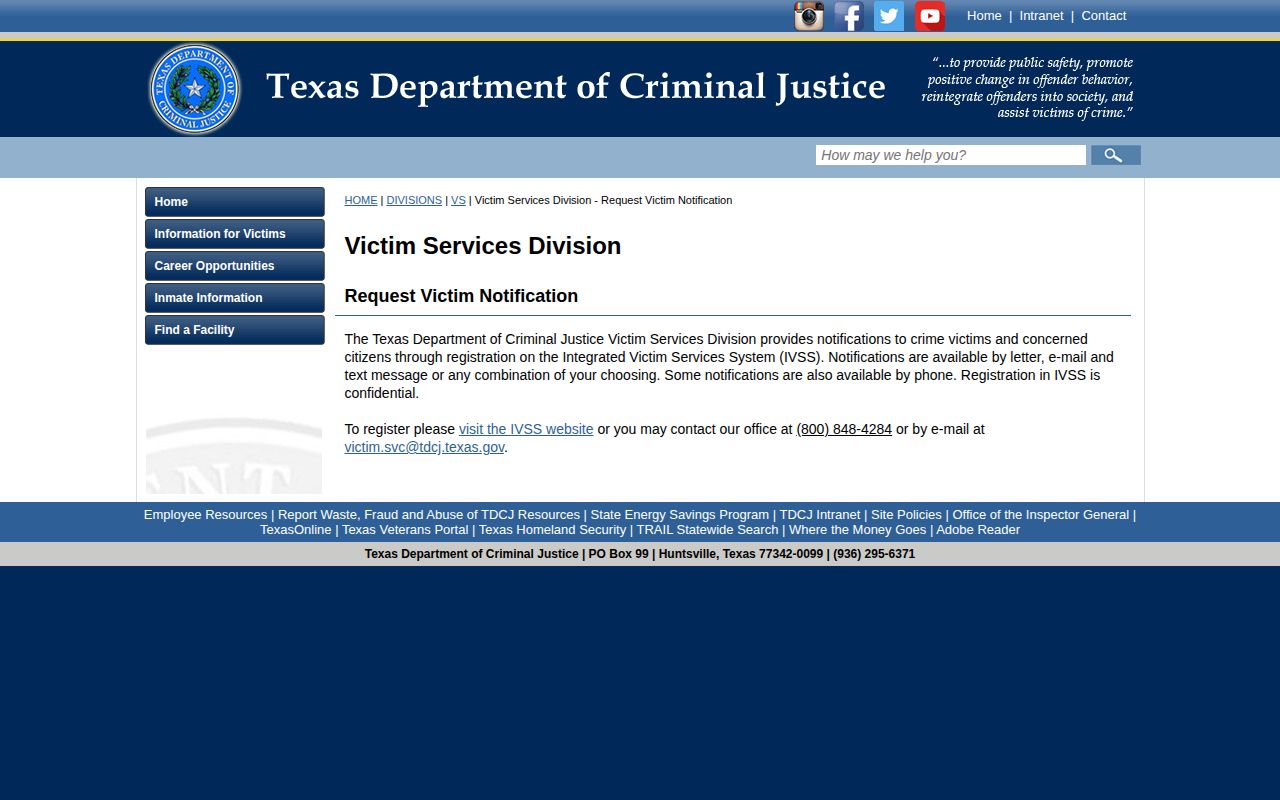
This screen belongs to the state layer, so it should not be used as proof that the San Saba courthouse probation office supervises a person.
San Saba Probation Court Records
The San Saba County/District Clerk is the durable source for a local probation case. A docket may show whether community supervision was ordered, deferred, changed, extended, revoked, or discharged. The signed judgment and later orders establish the legal status. They do not disclose every working supervision note, and they do not prove the precise time someone left physical custody.
San Saba combines county and district clerk functions on its official site, but case types remain distinct. County-level criminal matters and felony district matters follow different files. Justice and municipal cases can be held by those courts. No official public name-based criminal search was found, so identify the court from the cause number, citation, or judgment before requesting the record.
The clerk is at 500 E. Wallace, Suite 202, San Saba, TX 76877, (325) 372-3614. Published hours are Monday through Thursday, 8:00 a.m. to noon and 1:00 to 5:00 p.m.; Friday hours end at 4:00 p.m. Ask for the docket, judgment, supervision orders, and any discharge or revocation order tied to the cause.
Note: A court order may confirm supervision even when an office cannot disclose its operational case notes.
San Saba Parole Release Processing
A favorable BPP vote is not a completed release. TDCJ Review and Release Processing checks the release plan, residence rules, programs, discipline, and special conditions before issuing a certificate. Questions after a favorable vote belong with release processing, not local probation.
Before a Board vote, the parole-review status line is (844) 512-0461. After a favorable vote, the Parole Division release-status number is (512) 406-5202; callers should have the TDCJ number, SID, or date of birth. Review and Release Processing also lists (512) 406-5449. Keep a vote code, projected date, and actual departure date separate in verification notes.